

Katrin Bettina Müller
taz Berlin, 04. 08. 2016
To Ramble around Art
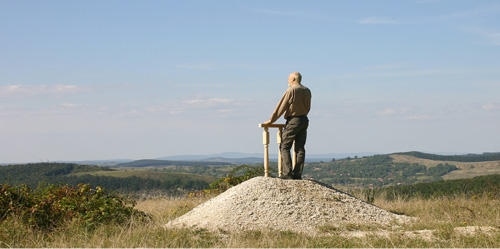
Christian Hasucha, Balustrade, photo: Christian Hasucha, 2014
The fixed is only an illusion: Christian Hasucha "unterwegs zuhause" in Galerie im Saalbau, Neukölln
Actually, it just looks like a hardened pile of gravel somewhere on a path. Noteworthy? For Christian Hasucha, yes. He discovered this small elevation on a country lane in Rumania, bought a balustrade from a DIY shop and put it on top. Now he leans on it and looks out over the gentle, wide, hilly landscape in front of him. The photo shows him from the back, almost like the classically romantic images of Caspar David Friedrich.
This 2014 motif is on the invitation card for Christian Hasucha's exhibition, "unterwegs zuhause" (on the road at home) in the Galerie im Saalbau, Neukölln. The title is typical for the methods and subject matter of this artist, who has his studio in the Karl-Marx-Strasse. Above all, he is a rambler and works while underway. He is a man of small gestures whose interventions in what are called public spaces are often quite unspectacular.
Perhaps it is exactly the light-handed and somehow modest presence of this artist, born in 1955, that is special in a time when a merciless competition for attention is taking place in public as well as virtual spaces in which the private is staged as public spectacle.
In the photo series, "Rumbulukr", made on a journey through Rumania, Bulgaria and the Ukraine, Hasucha works with text and small, black and white photos. He is again seen from behind in the images, a notebook in hand, between wooden boxes that look like suitcases. Sometimes two women look at him with curiosity, in the background high rise buildings in the city can be seen or earthworks on an area yet to be developed. Under each picture is a handwritten line: "Christian Hasucha writes about living in cities."

Christian Hasucha, RumBulUkr, photo: Christian Hasucha
His interventions in urban and landscape spaces often function as a test chart that is allied to our perceptive pattern of the city and the landscape, and shifts it a little, undermines it.
Sometimes they are sculptures, like a table that the artist built in the mountains by a coast, with a part of the mountain top jutting through the table top. These interventions, however, often only live on in documentation, in photos or short films. At one time, one can see a stone dance, animated in single images: a brief, high-spirited moment.
Sometimes one must move oneself to see anything at all. Building materials are arranged in a space in the gallery, boards lean against an unfinished wall cladding, blocks and paint buckets stand in front. A projection is initiated by a motion sensor and turns the arrangement into a three-dimensional support for the image of an ugly newly-built private home that is not yet plastered. The skeleton of the house appears to a certain extent in a place that should be fixed and secure: the fixed is only an illusion (and also ugly.)
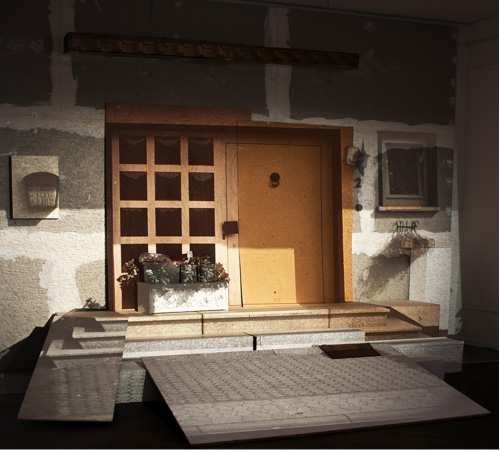
Christian Hasucha, Zuhause II, photo: Christian Hasucha
With Christian Hasucha, stillness and movement, at home and underway lose their opposition. He does not explicitly load it with social and political content or the contexts of gentrification and migration. His strategies appear to arise far more from an aesthetic interest, from the exploration of daily perceptions. And yet he also thus touches on existential questions - what is 'at home', how much does it need to be one, who has the power to define it - that are increasingly urgent in the present.